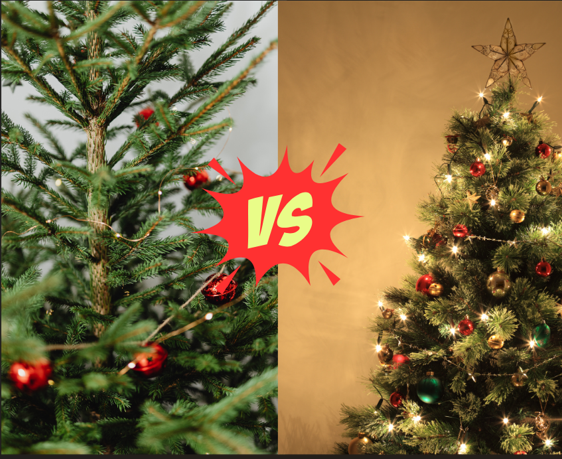
The festive season is approaching, and it’s time for one of Christmas’s biggest annual dilemmas: should you go for the real deal or bring out the artificial tree? We look at the pros, cons and environmental impact of both.
There’s something magical about decorating the Christmas tree. The fairy lights, the decorations collected over the years, the excitement of the kids (and perhaps the occasional argument about who gets to put the star on top!).
But before you head off to buy your Christmas tree or unpack last year’s artificial one, have you ever wondered which option is actually better for the environment?
You might think the answer is obvious. Surely a real tree is more environmentally friendly than a plastic one? Well, not necessarily! Like many sustainability questions, the answer is a little more complicated.
Let’s take a look.
🎄 The real deal: Natural Christmas trees
For many families, nothing beats a real Christmas tree. The fresh pine smell, the natural shape and the feeling of bringing a little piece of the outdoors into your home are hard to replicate.
But beyond the festive atmosphere, how does a real tree perform environmentally?
The pros
- A renewable resource: Most Christmas trees sold in Australia are grown specifically for this purpose on dedicated farms. They are not generally sourced by cutting down native forests. Once harvested, new seedlings can be planted to replace them.
- They absorb carbon dioxide: Like other trees, Christmas trees absorb CO₂ as they grow, storing carbon in their wood and contributing to the natural environment.
- Biodegradable: Once Christmas is over, a natural tree can be chipped into mulch, composted or recycled through suitable local collection programmes.
- Support local businesses: Buying from a nearby Christmas tree farm helps support local growers and reduces transport distances.
- No storage required: Once the festivities are over, you don’t need to find room in the garage for a giant box labelled ‘Christmas decorations’!
The cons
- Only lasts one season: Unless you choose a living potted tree, a cut Christmas tree is generally a one-Christmas affair.
- It can get messy: Beautiful as they are, falling needles are not everyone’s idea of festive fun. You might still be finding them in February!
- Transport matters: A tree transported over long distances can have a higher environmental footprint than one grown locally.
- How you dispose of it matters: Sending a natural tree to landfill is not ideal. Composting or mulching is generally a better option.
Our verdict: If you love a natural tree, look for a locally grown one and check whether the farm or your local council offers a recycling or mulching service. That way, your tree can have a second life after Christmas.
🎄 The convenient alternative: Artificial Christmas trees
Artificial trees have come a long way. Some look surprisingly realistic, require very little maintenance and can be reused year after year. For busy families, they can be a very convenient option.
But is that convenience worth the environmental cost?
The pros
- Reusable: A good-quality artificial tree can last many years, making it a practical option if you look after it.
- Less mess: No falling needles, no watering and no sticky sap on the floor. Your vacuum cleaner will thank you!
- Easy to assemble: Many artificial trees are designed to fold away neatly and can be ready to decorate in minutes.
- Predictable appearance: You can choose the exact size, shape and style you want, without worrying about finding the perfect natural tree.
The cons
- Made from plastic: Most artificial trees are made from PVC and metal, using materials derived from non-renewable resources.
- Manufacturing and transport: Many are manufactured overseas and shipped long distances before reaching Australian homes.
- Difficult to recycle: Because they combine different materials, artificial trees are generally difficult to recycle and often end up in landfill when discarded.
- Storage required: You need somewhere to keep them for the other eleven months of the year. Not ideal if storage space is already at a premium!
Our verdict: If you already own an artificial tree, the most sustainable thing you can do is keep using it for as long as possible. If you’re considering buying a new one, choose a durable option that you genuinely intend to use for many years.
So, which one is better for the environment?
Unfortunately, there isn’t one universal answer.
Artificial trees have a larger environmental footprint during manufacturing and transport, but their impact can be spread over many years of use. Natural trees are renewable and biodegradable, but their environmental credentials depend on how they are grown, transported and disposed of.
Estimates of how long an artificial tree needs to be reused to compete environmentally with a natural one vary considerably between studies. Some suggest around five years, while others suggest ten years or more, depending on the assumptions and environmental impacts being measured.
The University of Melbourne and Monash University have both highlighted the benefits of choosing locally grown natural trees, while also recognising the importance of reusing artificial trees rather than replacing them frequently.
The bottom line? If you already have a perfectly good artificial tree, don’t rush out to replace it with a real one in the name of sustainability. And if you prefer a natural tree, make sure it is responsibly sourced and properly recycled.
🌱 A third option: The potted Christmas tree
What if you could enjoy the best of both worlds?
A living Christmas tree in a pot can be a lovely alternative. With the right species and care, you can keep it alive after Christmas and bring it back year after year.
In Australia, you could even consider a native alternative, such as a Woolly Bush or Wollemi Pine, which can make a beautiful festive centrepiece.
Just remember that not every potted tree is suitable for indoor living or repeated relocation. Check its care requirements before buying and make sure you have somewhere suitable to keep it throughout the year.
5 simple ways to make your Christmas tree more sustainable
Whatever type of tree you choose, here are five ways to reduce its environmental footprint:
- Reuse what you already have. Whether it’s artificial or natural decorations, making the most of what you own is always a good starting point.
- Buy local. If choosing a real tree, look for a local grower to reduce transport emissions and support Australian businesses.
- Think about the end of its life. Check your local council’s Christmas tree recycling programme or arrange for your tree to be mulched or composted where suitable.
- Choose quality over quantity. If buying artificial, invest in a durable tree that you can enjoy for many years rather than replacing it every few seasons.
- Get creative with decorations. Reuse decorations from previous years, make your own with natural materials or give old decorations a new lease of life.
❤️ And remember, the best Christmas isn’t the one with the biggest tree!
At Party4Purpose, we believe that celebrating should be about creating memories, spending time with the people we love and giving back to the causes that matter to us.
Christmas doesn’t need to mean buying more, spending more or accumulating more things.
Whether your tree is real, artificial, potted or even a creative DIY version made from things you already have, what really matters is what happens around it.
So this Christmas, let’s turn the fun up, turn the waste down and put a little more purpose into our celebrations.
Because the best gifts aren’t always found under the Christmas tree!